

The Purple Guide (the industry-standard health and safety guide for UK event first aid) categorises medical requirements into tiers based on complexity and risk.
While the guide has moved toward a more flexible Medical Needs Assessment (MNA) approach, these tiers provide the baseline for what level of clinical skill and infrastructure is required for your event first aid requirements.
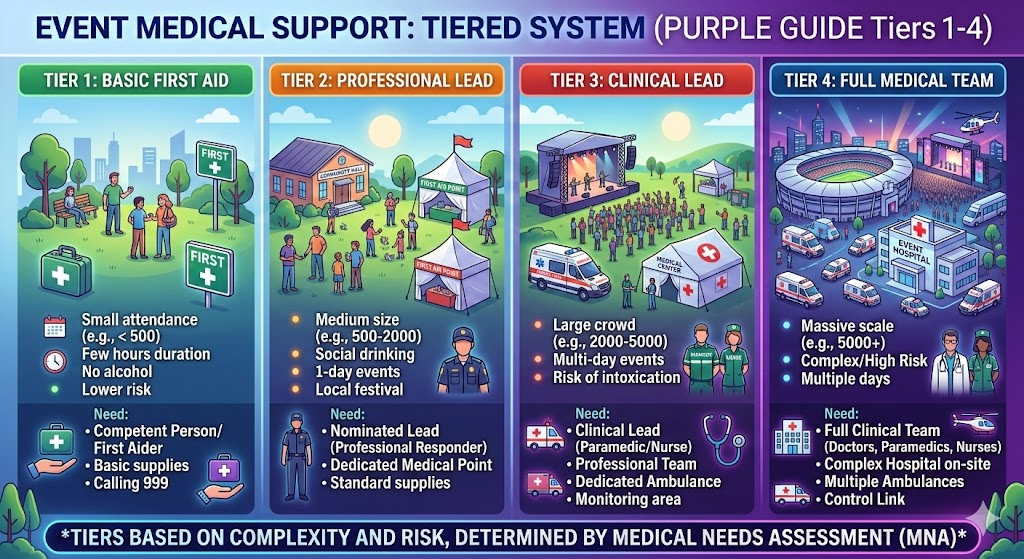
Quick Reference: The Four Main Tiers
The following table outlines the indicators and expected medical provision for Tiers 1 through 4.
| Tier | Typical Indicators | Required Event First Aid Provision |
| Tier 1 | < 500 attendees, low risk (no alcohol/drugs), few hours duration. | Basic First Aid: First aid kit and a competent person (First Aider) who knows how to call 999. |
| Tier 2 | 500–2,000 attendees, social drinking, low-risk activities, 1-day duration. | Professional Lead: Nominated medical lead, professional responders (ECAs/UCAs), and a dedicated medical point. |
| Tier 3 | 2,000–5,000 attendees, intoxication likely, moderate risk, multi-day. | Clinical Lead: HCPC Paramedic or Nurse lead, mixed clinical team, and at least one ambulance for transfers. |
| Tier 4 | 5,000–10,000+ attendees, complex/high-risk activities, multiple days. | Full Medical Team: Doctors, Paramedics, and Nurses. Dedicated on-site hospital/triage unit and multiple ambulances. |
Tier 1: Small & Simple Events
These are standard community gatherings like village fetes or small workshops where “hospital referrals are very unlikely.”
-
Staffing: Usually covered by volunteers or 1-2 trained First Aiders.
-
Focus: Minor cuts, grazes, or fainting.
-
Infrastructure: Portable first aid kits and knowledge of the nearest Public Access Defibrillator (PAD).
Tier 2: Medium-Sized / Low-Risk Events
Events such as local food festivals or charity runs. These often require a licensing agreement from the local authority.
-
Staffing: Should move away from volunteers to professional event medical staff (e.g., Emergency Care Assistants). A Nominated Lead must be responsible for the service on-site.
-
Infrastructure: A designated first aid post/room that is clearly signposted.
Tier 3: Larger Events / Moderate Risk
Music festivals, larger sports matches, or events spanning several days. The potential for serious illness or injury is considered “foreseeable.”
-
Staffing: Requires a Clinical Lead (Registered Healthcare Professional with pre-hospital experience). The team should include Paramedics and Nurses to handle stabilisation.
-
Infrastructure: A fully equipped medical center capable of monitoring patients. At least one ambulance must be on-site to handle hospital transfers without leaving the event uncovered.
Tier 4: Large & Complex Events
Major festivals or high-impact sporting events. These require a command-and-control structure.
-
Staffing: Multidisciplinary team including Doctors (often from Emergency Medicine or GP backgrounds), Nurses, and Paramedics.
-
Infrastructure: On-site medical facilities often include “Minor Injury” and “Illness” streams.
-
Management: Requires a formal Communication/Control Link (Radio dispatch) to coordinate multiple response teams across a large site.
Critical Requirement: The Medical Needs Assessment (MNA)
Regardless of the tier, the Purple Guide stresses that you cannot simply “count heads” to determine cover. Your Medical Provider must conduct a risk assessment considering:
-
Audience Profile: Age, history of drug/alcohol use, and previous casualty data.
-
Site Layout: Distance to the nearest A&E and ease of access for emergency vehicles.
-
Environmental Factors: Expected weather (heat exhaustion vs. hypothermia).
Note on CQC: If your medical provider plans to transport patients off-site in an ambulance, they must be registered with the Care Quality Commission (CQC). Using an unregistered provider for transport is a significant legal risk.
