

The Risks of Event Medical Ambulance RRVs
For event organisers and medical medical providers, Rapid Response Vehicles (RRVs) are often seen as the “gold standard” of a fast-acting event medical team. They can look professional, carry advanced kit, and—crucially—are often fitted retroreflective stickers and blue lights and sirens.
However, there is a significant legal and safety risk that many providers and organisers overlook. On the public highway, the legal right to use both certain retroreflective materials and blue lights is not as broad as many believe. Operating an RRV outside of strict legal definitions doesn’t just risk a fine; it can invalidate insurance and lead to criminal prosecution for the driver and sometimes, event organisers.
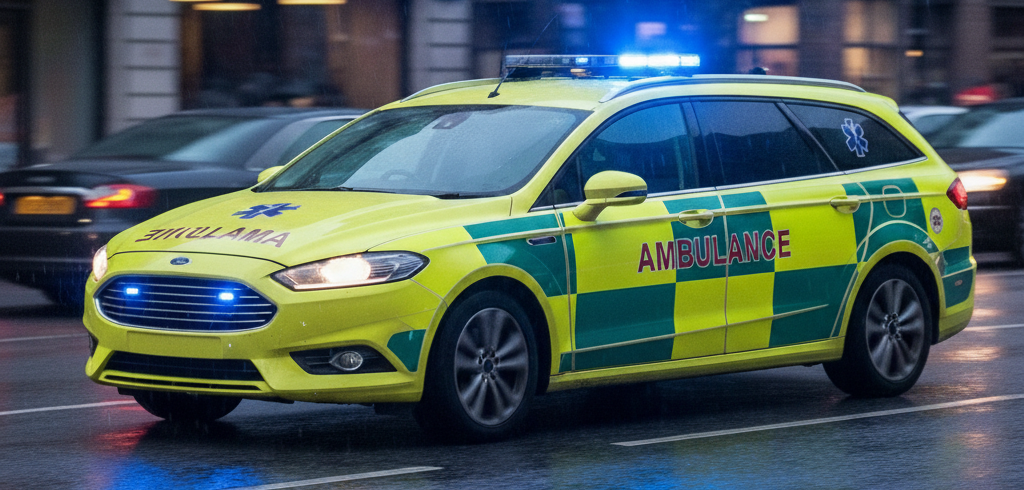
The Legal Reality: The “Stretcher” Rule
Under the Road Vehicles Lighting Regulations 1989 and the Road Traffic Act, the definition of an “ambulance” is surprisingly specific. While many private event medical companies operate cars (RRVs) with blue lights, the law is clear:
To be legally classified as an ambulance for the purposes of using blue lights and sirens on public roads, a vehicle must be primarily constructed or adapted for the carriage of sick and injured persons.
In practical terms, this means the vehicle must be fitted with a permanent stretcher or a dedicated means to carry a patient in a recumbent (lying down) position. Most standard RRVs—such as SUVs, estates, or hatchbacks—do not meet this criteria. Unless they are being used “for ambulance purposes” under the direct request of an NHS Ambulance Service (which provides a specific legal exemption), a private RRV without a stretcher is technically a private car.
What this means for you:
-
No Retroreflectives, Sirens or Blue Lights: On public roads, these vehicles cannot use emergency warnings to bypass traffic or clear junctions.
-
No Speed Exemptions: Without the “ambulance” classification, RRV drivers are not exempt from speed limits, red lights, or keep-left bollards.
-
Illegal Equipment: Even having the lights fitted to a vehicle that doesn’t meet the definition can be an offence.
The Risks of “Blue Light” RRVs at Events
When an RRV is contracted for event medical cover, the risks of ignoring these regulations are twofold:
1. Public Safety & Liability
If an RRV driver uses blue lights on a public road to reach a site or transport a clinician and is involved in a collision, the legal fallout is immense. Because the vehicle may not be legally classed as an “emergency vehicle,” the driver can be prosecuted for dangerous driving, and the event organiser may be held liable for failing to vet their contractors’ legal compliance.
2. On-Site vs. Off-Site Confusion
While “private land” (like a race circuit or festival site) has different rules, the moment that vehicle crosses the gate onto a public road, the Road Traffic Act applies. If your medical provider promises “emergency response times” from a base five miles away using an RRV, they may be planning to break the law to meet that target.
How to Stay Compliant
To protect your event and your attendees, you should ask your medical provider three critical questions during the planning stage:
-
Is the RRV legally registered as an ambulance (NOT NHSV) with the DVLA?.
-
Does the vehicle have a fixed stretcher or patient-carrying capability?
-
Do drivers hold a nationally recognised Level 3 Emergency Response Ambulance Driving (ERAD) qualification?
The safety of event-goers relies on a seamless “Chain of Survival.” When providers use vehicles that cannot transport or do not meet legal emergency standards, that chain is broken.
The “Onsite-Only” Transport Gap
A significant risk factor is the delay in definitive care (hospital treatment). If an Event Medical provider uses RRVs or ambulances “for onsite treatment only,” there is a mandatory wait for a statutory 999 service to arrive for transport.
-
NHS Response Times: As of late 2024/2025, the average response time for Category 2 calls in England often exceeds 30–40 minutes, far beyond the 18-minute national target.
-
The Risk: If an event medical provider cannot transport a patient because their RRV isn’t a legal ambulance, the patient is essentially waiting twice—once for the onsite team and once for the NHS.
Vehicle Compliance and Accidents
The legal status of a vehicle directly impacts safety statistics. Emergency response driving is one of the highest-risk activities on public roads.
-
Collision Rates: Research into emergency vehicle collisions suggests that “blue light” responses are significantly more likely to result in accidents than standard driving.
-
The Insurance Void: In the UK, if a vehicle is not registered as an “Ambulance” with the DVLA, standard “blue light” insurance is often voided upon discovery of a non-compliant vehicle. This leaves the driver and the event organiser personally liable for 100% of damages and injury claims.
Why “Onsite Only” Vehicle Risk Attendee Welfare
When an organiser hires a provider who uses Ambulances that are not regulated for transport on public road use, they are essentially hiring a “static” service masquerading as a “mobile” one.
-
The False Sense of Security: Organisers see an RRV with “Ambulance” markings and assume the vehicle can bypass traffic to reach the site or move between split-site events. If that vehicle is a standard SUV, it is legally a private car. If it gets stuck in traffic or causes an accident, the Medical Plan (Medical Needs Assessment) is effectively void.
-
Purple Guide Compliance: The HSG195 (Purple Guide) emphasizes that medical providers must be “fit for purpose.” A vehicle that cannot legally use its warning equipment to reach an emergency or transport a patient out of the site fails this test.
Concrete Numbers for Your Report:
-
DVLA Classification: Only vehicles with the taxation class “Ambulance” are exempt from vehicle excise duty and, more importantly, are recognized for “ambulance purposes.”
-
Stretcher Requirement: To meet the “Ambulance Purposes” definition under the Road Vehicles (Construction and Use) Regulations, the vehicle must accommodate a patient in a recumbent position. 0% of standard SUV RRVs meet this requirement without significant (and rare) interior structural modification.
Conclusion: Protecting the Event
Using “onsite treatment only” vehicles that mimic emergency ambulances creates a “legal trap.” If a life-threatening incident occurs and the onsite RRV cannot legally clear traffic to assist or cannot transport the patient, the coroner’s inquest or Health and Safety Executive (HSE) will look directly at the organiser’s due diligence.
Conclusion
RRVs are incredible tools for getting a paramedic to a patient quickly within an event site. However, they are not a “get out of traffic free” card. Using them as such is a gamble with the law and public safety. Click here for more advice or information on what you are required to provide, or what can be used as a suitable alternative to RRVs for Event Medical Cover.
